
Will Artificial Intelligence Become A Moderating Influence In Society?
Social media nudges people toward the extremes. Chatbots nudge them to the centre.


I want to highlight an interesting chart I ran into on X that originally came from the Financial Times:
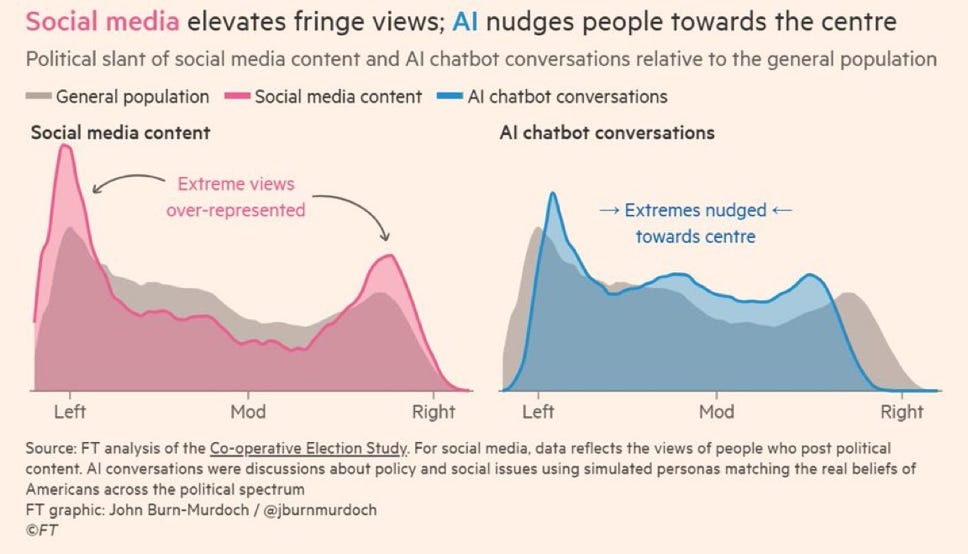
For the past two decades, the social architecture of the internet has rewarded emotional intensity, which often translates into political extremism. Anger and rage travels faster than restraint or nuance, because platforms promote content that holds a user’s attention. In that environment, certainty tends to outperform hesitation. On platforms built around pumping out the most viral or sticky content, the incentive is to come out with views that stand out and get noticed. That naturally favours content from the poles rather than the centre.
AI systems, at least in their current mainstream form, are built differently. They are usually trained to try to be helpful, careful, non-inflammatory, and context-sensitive. When a user expresses a highly partisan or emotionally charged position, the model is set-up to respond by trying to “broaden the frame”, introduce caveats, and acknowledge tradeoffs. Sometimes it will explicitly present the opposing case in more human terms. Instead of intensifying rhetoric, it often softens it.
Of course, there’s a caveat: AI can also be used to generate fake images, fake videos, fake voices, fake evidence—all the things many of us were primed to be most scared of when these tools first entered public consciousness.
The ability to fabricate realistic media at scale represents a real threat to social trust. It lowers the cost of propaganda. It muddies the distinction between what happened and what merely looks like it happened. It gives bad actors new tools for manipulation, harassment, fraud, and political deception. And people stop believing true things because they know false things can now be manufactured so easily. I’ve already watched this happen many times.
Only a few weeks ago, a large number of people on the anti-Israel side of X decided that Benjamin Netanyahu was dead, perhaps as a response to the death of Ayatollah Khamenei. Large numbers of accounts started claiming that a recent video of Netanyahu visiting a coffee shop was a “deep fake”.

Of course, the video was real. Netanyahu is alive. He has been filmed in public locations many times since, including voting in the Israeli Knesset. But that didn’t stop a whole load of people falsely claiming he was dead. This is a weird and peculiar phenomenon, and going forward it means that whatever happens, vast numbers of people will scream “deep fake” and “AI” at anything and everything. There will also, of course, also be vast numbers of actual deep fakes. This is, in some ways, a nightmarish scenario for public trust.
But what wasn’t so widely foreseen was that AI might introduce a very different social dynamic at the same time: the normalisation of a calmer, more moderating style of discourse.
A chatbot operates under a different logic to social media users. It is not trying to win applause from any kind of audience nor accumulate followers nor go viral. It’s just a mechanistic system generating responses to prompts. So even when a user approaches it with a highly charged perspective, the system often responds by cooling the temperature a little.
I think that there is a demand in society for moderacy. Most people, after all, do not spend their lives wanting to inhabit a permanent state of outrage. They get pulled into it because the systems around them reward it. They are exposed to a constant stream of content designed to provoke and inflame. Over time, this creates the impression that extremity is normal and every issue must be understood in the most totalising terms, and that every disagreement is a civilisational confrontation.
Some people have dealt with this issue by stepping away from social media. They have deleted the apps altogether, or left larger and more controversial apps (like X) and chosen to spend time on smaller and less controversial apps (like Substack).
Another response has been the growth of offline social movements and in-person communities that seem, in part, like a reaction against the conditions of digital life.
You can see this in all sorts of places: religious revival among younger people, renewed interest in local community groups, the return of reading circles, running clubs, men’s groups, women’s groups, amateur societies, political meet-ups, mutual aid networks, and countless other efforts to rebuild some kind of embodied social fabric. Not all of these movements are politically moderate, obviously. Some are eccentric, some ideological, some intensely partisan. But many of them seem driven by the same impulse: a desire to escape the flattening, deranging atmosphere of online existence and return to forms of association that feel more localised and human.
For me, at this point, I think it’s very clear that social media is failing, somehow. And I say this as someone who has improved my life many times by connecting with likeminded people through social media.
I hope that the proliferation of AI chatbots will cool the heat somewhat. But, of course, there is also a possibility that for a politically inflamed world, we may eventually see the rise of more-politicised chatbots that take harsher political stances, and seek to reinforce their users’ biases, rather than challenge them. No doubt, AI companies will also become targets for political takeovers, like the takeover of Twitter (now X) by Elon Musk, too.
Thanks John. Many good insights.
Hopefully you are correct about AI moderating our rages or infatuations.
Social media reminds me of a song from 1980. “Looking for love in the wrong places”
The title became a moral warning in the years since.
For this topic, Google AI does good and explains as follows, in my reply.
Very interesting trend. Elon has his own AI company, xAI which publishes Grok. I’m not sure how chatbots will help young people become better socialized. This is a scary trend, too: A entire badly-educated, medicalized generation reared to take cues from social media.